Introduction
Sourcing ring gears shouldn't be this complicated — yet procurement teams routinely encounter 16-week lead times, inconsistent AGMA quality ratings, and suppliers who quote confidently but lack the in-house capability to deliver. The global supplier landscape spans large multinationals like ZF and Timken down to precision job shops serving aerospace, defense, and MRO markets. Choosing the wrong tier can mean scrapped parts, missed production windows, or quality failures at the worst possible moment.
This guide gives procurement teams a practical framework for cutting through that complexity. You'll learn how to evaluate manufacturers on AGMA quality ratings, in-house grinding and cutting capabilities, and application-specific experience. We also break down the domestic versus overseas trade-off — covering lead times, quality risks, and total landed cost — so you can make the right call whether you're placing a commodity order or sourcing precision-critical custom gears.
Key Takeaways
- Ring gears transmit torque in planetary assemblies, differentials, and large rotating equipment across aerospace, defense, mining, and industrial sectors
- Global manufacturers range from multinationals (ZF, Timken, SKF) to specialized regional shops, each optimized for different order volumes and tolerance classes
- When evaluating suppliers, prioritize AGMA quality ratings, in-house capabilities, and verified AGMA ratings (ANSI/AGMA 2015-1-A01 or ISO 1328-1:2013), in-house process control, and documented sector experience
- US precision shops provide shorter lead times, stronger IP protections, and direct responsiveness — critical advantages for custom or defense/aerospace work
What Is a Mechanical Ring Gear and Where Is It Used?
A ring gear (also called an annular gear or crown gear) is a circular gear with teeth on the inner or outer circumference. It transmits torque and rotational motion in compact gear systems such as planetary assemblies and differentials. According to ISO 1122-1:1998, an annulus gear is defined as the outermost gear with internal teeth in an epicyclic train.
Internal vs. External Ring Gear Configurations
Internal ring gears mesh with planet gears orbiting a central sun gear, creating compact, high-torque transmission assemblies for planetary gear systems. Producing them requires specialized equipment — hobbing, shaping, or broaching — and precise control of tooth geometry within a constrained space.
External ring gears carry teeth on the outer circumference and appear in large rotating equipment such as slewing rings, crusher drives, and mill gearboxes. Some exceed 4,500mm in diameter, demanding different tooling, heat treatment, and inspection protocols than internal designs.
Primary Industrial Applications
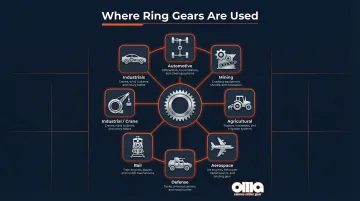
Ring gears serve key functions across multiple sectors:
- Automotive transmissions and differentials – Power distribution in drivetrains and e-Axles
- Mining equipment and crushers – Gyratory and cone crusher drives handling extreme loads
- Agricultural machinery – Final drive assemblies and planetary hubs in tractors and harvesters
- Aerospace actuation systems – Flight control mechanisms requiring high precision and reliability
- Defense drivetrains – Turret rings and reduction gearboxes for military vehicles
- Rail systems – Traction motor gear units for locomotives and transit systems
- Industrial process equipment – Slewing rings for cranes, wind turbines, and rotating machinery
The Global Ring Gear Manufacturing Landscape
Ring gear production concentrates in distinct regions, each with different strengths:
North America hosts precision job shops and OEM suppliers serving aerospace, defense, and custom industrial applications. US manufacturers excel in low-to-mid volume runs, tight tolerances, and rapid engineering support.
Germany and Western Europe dominate high-precision engineering for robotics, automotive, and automation. German conglomerates like ZF integrate ring gears into complete transmission systems.
Japan leads in bearing and driveline integration, with companies like NSK and NTN producing precision gears for robotics and automation applications.
China provides high-volume commodity production at competitive pricing, though quality verification and longer lead times (typically 30-45 days for bulk orders) remain considerations.
India offers cost-competitive mid-range manufacturing, balancing price and capability for industrial applications.
Market Growth and Reshoring Trends
The global gear market is projected to reach $294.03 billion by 2030, growing at a 5.77% CAGR. The precision gearbox segment is expanding even faster at 9.9% CAGR, driven by robotics and automation demand.
Post-pandemic supply chain disruptions accelerated reshoring momentum. US reshoring and FDI job announcements reached a record 360,000+ in 2022, a 53% increase from 2021. That momentum reflects a broader recalculation: when buyers factor in tariffs, freight costs, and delivery risk, domestic or regional sourcing often wins on total cost for precision components.
How Sourcing Needs Vary by Buyer Type
Different buyers approach ring gear sourcing with fundamentally different priorities.
| Buyer Type | Key Priorities | What They Need from a Supplier |
|---|---|---|
| High-volume OEMs | Economies of scale, standardized specs | Established logistics, integrated drivetrain solutions |
| MRO buyers | Replacement parts for aging equipment | Reverse engineering from samples or worn parts |
| Defense / Aerospace | ITAR compliance, AS9100, domestic sourcing | Traceability, precision, supply chain security |
| Custom engineers | Non-standard specs, fast iteration | Low-volume flexibility, prototype support |
Key Criteria for Evaluating Ring Gear Manufacturers
Quality Standards and Certifications
CRITICAL UPDATE: The legacy AGMA 2000-A88 standard (Q3-Q15 quality numbering system) has been officially withdrawn and is obsolete. Procurement teams must update RFQs to specify current ANSI/AGMA 2015-1-A01 or ISO 1328-1:2013 accuracy grades.
Understanding the New System:
In the current standards, lower numbers indicate higher precision—the opposite of the old Q-number system. For example:
- AGMA A2 or ISO Grade 2 = Highest precision (ground gears)
- AGMA A10 or ISO Grade 10 = Standard precision (hobbed/shaped gears)
A precision manufacturer like Carnes-Miller Gear achieves AGMA 10 on shaped and hobbed gears and AGMA 13 on ground spur and heat-treated gears—concrete benchmarks across different manufacturing processes.
Essential Quality Management Certifications:
| Certification | Focus | Primary Sectors |
|---|---|---|
| ISO 9001:2015 | Baseline quality management system | General industrial, MRO, heavy machinery |
| IATF 16949:2016 | Defect prevention and supply chain variation reduction | Automotive OEMs, Tier-1 suppliers |
| AS9100D | Aviation, space, and defense requirements | Aerospace actuation, defense drivetrains |
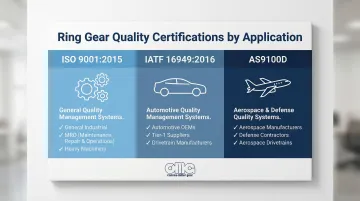
Buyer Action: Request certification documentation—don't rely on self-reported claims. Verify that certifications are current and scope-appropriate for your application.
Manufacturing Capabilities and Customization Depth
Full-service manufacturers consolidate multiple processes in-house, reducing lead times and quality variability. Look for these capabilities:
- Gear blanking – In-house blank production ensures material traceability
- Hobbing and shaping – Primary tooth-cutting processes for internal and external gears
- Milling – Keyways, mounting features, and secondary operations
- Grinding – Achieves highest precision (AGMA 13/ISO Grade 2) and superior surface finish
- Broaching – Internal splines and keyways with tight tolerances
- Heat treatment – Carburizing, hardening, and tempering for wear resistance
- Nital-etch testing – Detects grinding burns that compromise gear strength
Customization Capability Matters Most For:
- Reverse engineering obsolete equipment when OEM support ends
- Low-to-mid volume custom assemblies (10-500 units)
- Non-standard dimensional requirements outside catalog specs
- Specialized testing equipment requiring unique gear geometries
Buyers sourcing replacement parts or specialized equipment should specifically vet reverse engineering experience and low-volume capabilities.
Application Experience and Industry Track Record
Gear requirements vary sharply by industry:
- Aerospace – AS9100 certification and full material traceability
- Mining – Extreme load ratings and abrasion-resistant materials
- Defense – ITAR compliance and domestic production requirements
A supplier with 50+ years of production history brings deep institutional knowledge of:
- Gear tooling selection and optimization
- Equipment capabilities and limitations
- Industry-specific nomenclature and tolerancing conventions
- Common failure modes and design improvements
That depth of experience directly affects output quality: a shop that has machined gears for a specific industry for decades has already solved the problems a newer supplier will encounter on your first order.
A Look at Notable Ring Gear Manufacturers Worldwide
Large Multinational OEM Suppliers
These global suppliers serve large OEM programs with deep vertical integration and established supply chains. Expect high minimum order quantities, long development cycles, and pricing structured around volume.
ZF Friedrichshafen AG (Germany)
- Integrated transmission systems, industrial planetary gearboxes, wind and marine gears
- Serves heavy industry OEMs, wind energy, marine propulsion, and automotive
- Complete drivetrain integration with a global service network
- Best for high-volume programs; custom specs require long development cycles
Dana Incorporated (USA)
- Light and commercial vehicle differentials, e-Axles, and off-highway drivetrains
- Primary customer base: automotive and commercial vehicle OEMs
- Strong North American production with growing e-mobility expertise
- Optimized for high-volume runs; limited flexibility for low-volume orders
Timken Company (USA)
- Large-diameter slewing rings from 300mm to 4,500mm OD, heavy industry bearings
- Serves mining, wind, crane, and defense applications
- Custom engineering capability for large-scale, demanding environments
- Premium pricing reflects complex specification and engineering support
SKF Group (Sweden)
- RKS Series slewing bearings with integrated internal gears
- Serves robotics, construction, and wind energy buyers
- Standard sizes in stock; custom solutions available up to 14,000mm OD
- Primarily bearing-integrated — not a standalone ring gear source
GKN Automotive (UK)
- Forged PM differential gears and planetary gear sets for eDrive systems
- Supplies automotive OEMs and Tier-1 eDrive integrators
- Advanced powder metallurgy processes with lightweighting expertise
- High-volume automotive focus; not suited for small-batch or custom orders
Regional and Specialized Manufacturers
When program volumes don't justify a multinational supplier — or when precision tolerances, fast turnaround, or custom engineering matter more than unit price — regional and specialized manufacturers fill the gap.
American Axle & Manufacturing (AAM)
- Net-forged annulus ring gears and differential assemblies for heavy-duty applications
- Serves commercial vehicle OEMs and off-highway equipment manufacturers
- North American production with strong metal forming expertise
KHK Gears (Japan/USA)
- Stock internal gears (Module 0.5 to 3.0) with no MOQ requirement
- Custom ground gears up to 500mm OD; 3-day factory-direct US shipping on stock items
- Best for rapid prototyping, job shops, and small OEMs with immediate needs
Eaton Corporation (USA)
- Open differentials (planetary and bevel) and automated transmissions
- Serves commercial vehicle OEMs and industrial power management applications
- Integrated power management solutions across drivetrain platforms
US Precision Job Shops
Smaller specialized manufacturers serve aerospace, defense, medical, and custom industrial applications where AGMA-certified tolerances, reverse engineering, and fast turnaround matter more than unit price. These shops typically offer:
- Custom manufacturing from samples or drawings
- In-house grinding and heat treatment
- Nital-etch testing for quality verification
- 2-week lead times when special tooling isn't required
- Direct engineering communication
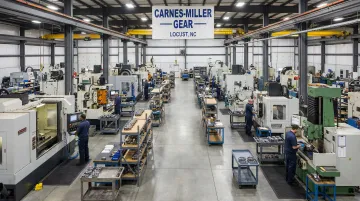
For example, Carnes-Miller Gear operates an 18,000-square-foot facility in Locust, NC, with 50+ years of experience serving aerospace, defense, and custom industrial applications. Their in-house capabilities include grinding (up to 400mm), hobbing, shaping, broaching, and nital-etch testing—enabling complete control over production quality and delivery.
Domestic vs. Overseas Ring Gear Sourcing: What Industrial Buyers Should Consider
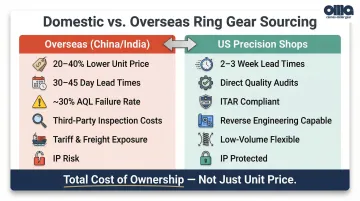
Total Cost of Ownership, Not Just Unit Price
Overseas manufacturers—particularly Chinese and Indian suppliers—typically offer 20-40% lower per-unit pricing on commodity ring gears. However, buyers must account for:
- Container freight and expedited shipping erode price advantages
- Import duties – US tariffs on gears (HTS 8483) carry 2.5% base rate, plus Section 301 tariffs on Chinese imports
- Lead times run 30-45 days for bulk orders from China vs. 2-3 weeks for domestic job shops
- Quality inspection costs – Third-party inspections in China average $299 per man-day
- Typical AQL failure rates for Chinese shipments hover around 30%, adding rework and warranty exposure
For small-to-mid volume precision orders, these hidden costs often eliminate the FOB price advantage.
Quality Control Challenges in Offshore Sourcing
Verifying dimensional accuracy, heat treatment depth, and surface finish across an ocean supply chain requires either on-site auditing or third-party inspection. Even well-regarded suppliers can deliver inconsistent results when production volumes surge or when new subcontractors enter the supply chain without adequate oversight.
ISO 1328-1:2013 establishes flank tolerance classification for cylindrical involute gears, but enforcement varies by region. Domestic suppliers offer easier facility tours, direct quality audits, and faster resolution of non-conformance issues.
When Those Offshore Risks Tip the Scale Toward Domestic
For buyers where downtime, compliance, or precision tolerances aren't negotiable, domestic sourcing often makes more financial sense than the unit price differential suggests.
Time-Sensitive or MRO Applications:
- Faster turnaround for replacement parts (2-3 weeks vs. 6-16 weeks)
- Reduced equipment downtime costs
- Ability to expedite critical orders
Precision-Critical Applications:
- Direct engineering communication for custom specs
- In-person meetings to resolve tolerance questions
- Real-time adjustments during prototype development
Defense and Aerospace Supply Chains:
- ITAR compliance requirements favor domestic production
- AS9100 certification easier to verify and audit
- Supply chain security and IP protection
- Facility access for government audits
Custom or Reverse-Engineered Gears:
- Collaborative engineering for obsolete equipment replication
- Low-volume runs (10-500 units) economically viable
- Specialized testing and validation (nital-etch, dimensional inspection)
The Right-Fit Domestic Solution
Specialized US precision manufacturers serve buyers who need custom ring gears, reverse-engineered replacements, or high-tolerance components for aerospace, defense, or medical applications. These shops offer:
- Full in-house capabilities (blanking, hobbing, shaping, grinding, broaching)
- AGMA-rated output with documented quality systems
- 50+ years of hands-on experience in gear tooling and tolerancing
- Fast turnaround on design revisions and prototypes
- Competitive pricing through operational efficiency
For example, Carnes-Miller Gear's 50+ years of experience enables reverse engineering from samples, custom modifications (lead, profile, tip relief), and gear salvage for heat treat distortion—capabilities that matter when equipment downtime is expensive or when ITAR compliance is required.
Frequently Asked Questions
Who makes ring gears?
Ring gear manufacturers range from large global corporations like ZF, Timken, Dana, and SKF to specialized regional shops and precision job shops in the US. The right manufacturer depends on your volume requirements, tolerance specifications, and industry application—high-volume OEMs typically partner with multinationals, while custom or defense applications often require specialized domestic precision shops.
What industries use ring gears most heavily?
The top sectors are automotive (differentials and transmissions), mining (crusher and mill drives), agricultural equipment (final drives), aerospace (actuation systems), defense drivetrains, rail systems, and general industrial machinery. Each sector carries distinct load, material, and environmental requirements—so match the manufacturer's industry experience to your application.
What is the difference between an internal and external ring gear?
Internal ring gears have teeth on the inside circumference and are commonly used in planetary gear assemblies where planet gears orbit around a central sun gear. External ring gears have teeth on the outer circumference and are used in large rotating industrial equipment such as slewing rings and crusher drives.
What quality standards should I look for when sourcing ring gears?
Look for ANSI/AGMA 2015-1-A01 or ISO 1328-1:2013 accuracy grades as the primary US standard for gear accuracy. Also verify ISO 9001 for quality management, AS9100 for aerospace applications, and IATF 16949 for automotive suppliers.
Can ring gears be custom-manufactured to specific tolerances?
Yes, specialized manufacturers can produce custom ring gears to print or reverse-engineer obsolete gears from samples. Look for shops with in-house gear grinding, hobbing, and shaping capabilities to handle tight-tolerance custom work—integrated in-house capabilities reduce lead times and maintain tighter quality control than multi-vendor supply chains. Carnes-Miller Gear, for example, achieves AGMA 13 ratings on ground spur and heat-treated gears with full reverse engineering capability.
How do I decide between a domestic and overseas ring gear manufacturer?
Weigh total cost of ownership—not just unit price—factoring in lead time, shipping, import duties, quality verification, and IP risk. For custom work, low-volume orders, or defense and aerospace applications where ITAR compliance and supply chain security matter, domestic precision manufacturers are typically the stronger choice.