Introduction
Industrial buyers and OEM manufacturers face a complex challenge when sourcing precision gears: balancing exacting performance requirements with lead times, cost control, and supplier reliability in high-stakes environments like aerospace, mining, defense, and medical equipment. A single gear failure in a mining excavator can cost tens of thousands in lost production time; a defective gear in an aircraft accessory gearbox can compromise safety.
Helical gears are the preferred choice for demanding industrial applications due to their superior load distribution, quiet operation, and extended service life. Yet not all helical gear manufacturers deliver the precision, quality documentation, and engineering support that critical applications require.
This guide covers what makes helical gears mechanically superior, what to evaluate in a wholesale manufacturer, and how to make sourcing decisions that protect your operations and bottom line.
TLDR:
- Helical gears captured 36.9% of the $31.9 billion global gearbox market in 2025, driven by automation and heavy machinery demands
- Progressive tooth engagement reduces noise and extends fatigue life up to 2x versus spur gears
- Specify ISO 1328-1:2013 grades explicitly; the AGMA/ISO transition creates room for mediocre components to slip through
- Nital-etch testing (SAE AMS 2649) is mandatory for aerospace and defense to catch grinding burns before they cause failure
- Manufacturers with comprehensive in-house capabilities — hobbing, grinding, broaching — reduce subcontractor risk and tighten quality control
What Are Helical Gears and How Do They Work?
Helical gears are cylindrical gears with teeth cut at an angle—the helix angle—to the gear axis, unlike straight-cut spur gears. That angled geometry changes how power is transmitted: helical teeth engage progressively rather than all at once, with the load distributed gradually as teeth slide into contact.
Manufacturing Process and Quality Impact
Helical gears are produced through a multi-stage process where each step directly affects final performance:
- Cut the helical tooth form via hobbing or shaping using specialized tooling
- Apply heat treatment—carburizing, through-hardening, or nitriding—to achieve target surface hardness and core strength
- Grind post-heat-treat to achieve tight tolerances (AGMA 13 / ISO Grade 5 or better)
- Validate dimensions, perform nital-etch testing for grinding burns, and document gear charts
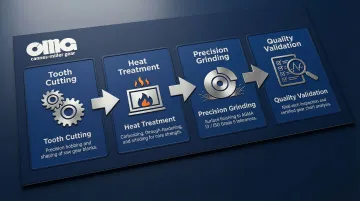
Each step builds on the last—and errors compound just as easily as quality does. Aggressive grinding after heat treatment can introduce thermal damage (grinding burns) that drastically reduces surface fatigue life but remains invisible without chemical testing.
Configuration Types
Helical gears come in two main configurations:
- Parallel shaft: Most common in industrial gearboxes, where both gears have the same helix angle but opposite hand (one right-hand, one left-hand)
- Crossed-axis (skew gears): Used in lighter-load applications where shafts are not parallel; contact is point-based rather than line-based, limiting torque capacity
Key Advantages of Helical Gears for Industrial Applications
Gradual Tooth Engagement Reduces Shock Loading
The primary mechanical advantage of helical gears is their gradual tooth engagement. While spur gear teeth meet along their entire width simultaneously in an abrupt line contact, helical teeth slide into place progressively. This increases the contact ratio—the average number of tooth pairs in contact at any given moment—from typically 1.1–1.7 for spur gears to 2.0 or higher for helical gears.
NASA testing on high-contact-ratio gears demonstrates that the 10-percent pitting fatigue life of high-contact-ratio gears was approximately two times that of standard gears at the same load level. The result is quieter operation and measurably lower vibration, which matters in environments like medical facilities and aerospace cabins where noise and mechanical shock tolerances are tight.
Superior Load-Bearing Capacity
Because multiple teeth share the load at any given moment, helical gears transmit higher torque and handle heavier duty cycles than equivalent spur gears. The distributed contact reduces stress concentration on individual teeth. That's why helical gears are the default choice for:
- Mining conveyor drives running under continuous heavy load
- Rail traction systems demanding sustained torque output
- Industrial gearboxes where duty cycle intensity rules out lighter alternatives
Efficiency and High-Speed Capability
Helical gears operate efficiently at higher speeds (RPMs) with less vibration. Mechanical efficiencies of 98.0% to 99.5% are achievable in properly designed helical meshes. However, at speeds exceeding 10,000 RPM, windage (air resistance) losses can equal or exceed mechanical friction, requiring proper shrouding and optimized lubrication in high-speed aerospace and turbine applications.
Extended Service Life
The distributed contact pattern reduces both peak bending stress and Hertzian contact stress compared to the instantaneous line contact of spur gears. In mining, rail, and construction equipment—where unplanned downtime carries real financial consequences—this translates to longer intervals between replacements and fewer emergency rebuilds.
The Axial Thrust Trade-Off
The helix angle inherently generates axial thrust—a force parallel to the gear's axis that pushes the gear along the shaft. Its magnitude scales with transmitted load and the tangent of the helix angle. Standard ball bearings aren't rated for this combined radial and axial loading.
Proper engineering requires:
- Tapered roller bearings or angular contact thrust bearings arranged in opposing pairs
- Double-helical (herringbone) gears for extreme-load applications, where opposing helix angles cancel out thrust forces internally
Specifying the wrong bearing arrangement here is a common failure point—getting this right at the design stage avoids costly gearbox rebuilds in the field.
Industries That Rely on Helical Gears
Helical gears are the standard across sectors where reliability, quiet operation, and high torque capacity are non-negotiable:
High-Demand Applications:
- Aerospace and Defense: Helicopter rotor systems, accessory gearboxes, and turbine engine drives require extreme precision, tight tolerances, and full material traceability
- Industrial Machinery: High-torque gearboxes and continuous-duty conveyors run harder and longer when helical gear geometry distributes load across multiple teeth simultaneously
- Mining and Construction: Excavator final drives and heavy-load conveyor systems face shock loads that would destroy less capable gear types
- Transportation and Rail: Locomotive traction drives and transit gearboxes depend on smooth, consistent power transmission across millions of operating cycles
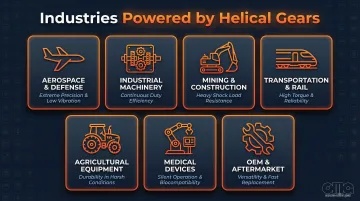
Additional Sectors Served:
- Agricultural Equipment: Combine harvesters and tractor transmissions, where field reliability outweighs all other concerns
- Medical Devices: Surgical robotics and diagnostic imaging equipment, where even minimal vibration compromises accuracy
- OEM and Aftermarket: Custom machinery builds and legacy equipment replacement parts across virtually every industry
Each sector demands different material grades, coatings, heat treatments, and tolerance classes. Carnes-Miller Gear has manufactured to spec for all of these industries since 1973 — from AGMA 13-rated ground spur gears for aerospace to heavy-duty agricultural drives — which means fewer revision cycles and faster approval from your engineering team.
What to Look for in a Helical Gear Wholesale Manufacturer
AGMA Quality Ratings and ISO Standards
The gear industry is transitioning from legacy ANSI/AGMA 2000-A88 (where higher Q-numbers like Q13 meant better quality) to ISO 1328-1:2013 (where lower grades like A2 mean better quality). This creates confusion: a supplier quoting "Grade 6" could mean mediocre quality under the old system or high precision under the current ISO standard. The gear industry is transitioning from legacy ANSI/AGMA 2000-A88 (where higher Q-numbers like Q13 meant better quality) to ISO 1328-1:2013 (where lower grades like A2 mean better quality). This creates real confusion at the purchasing stage — a supplier quoting "Grade 6" could mean mediocre quality under the old system or high precision under the current one. See AGMA and ISO gear quality standards for a full breakdown of where the two systems diverge.
Critical for buyers:
- Explicitly state the standard and year on purchase orders (e.g., "ISO 1328-1:2013 Grade 5")
- AGMA 10–13 range (or ISO A2-A5) is appropriate for precision industrial applications
- Higher precision grades require tighter tolerances on cumulative pitch, profile, helix (lead), and surface finish
In-House Capabilities vs. Outsourced Processes
A manufacturer with full in-house gear blanking, hobbing, shaping, grinding, and broaching offers a meaningful edge over shops that outsource key steps. A manufacturer with full in-house gear blanking, hobbing, shaping, grinding, and broaching offers:
- Eliminates dimensional variation that subcontractors can introduce
- Avoids delays waiting on external heat treat or grinding queues
- Creates a single point of accountability when defects need to be resolved
Outsourcing critical finishing steps like profile grinding increases the risk of undetected defects. Under AS9100 aerospace quality standards, the OEM retains ultimate responsibility for the conformity of all externally provided special processes.
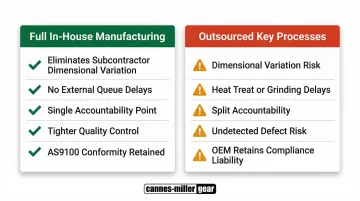
Carnes-Miller Gear handles all of these processes in-house at its 18,000-square-foot facility in Locust, NC — including gear blanking, hobbing, shaping, grinding up to 400mm, and broaching — which directly reduces the supplier coordination risk described above.
Material and Heat Treatment Expertise
Ask whether the supplier:
- Handles heat treatment in-house or partners with certified facilities
- Performs post-grind quality checks like nital-etch testing to detect grinding burns
Per SAE AMS 2649 and ISO 14104, nital-etch testing reveals grinding burns — localized thermal damage that drastically reduces surface fatigue life but is invisible to the naked eye. Undetected burns cause premature gear failure. This test is mandatory for aerospace, defense, and high-stress industrial gears.
Reverse Engineering and Custom Capability
For OEM buyers sourcing replacement gears for legacy equipment, reverse engineering capability is a major advantage. A manufacturer that can work from worn samples or partial drawings solves costly aftermarket and MRO sourcing problems when original drawings are lost or incomplete.
Carnes-Miller Gear's reverse engineering capability makes it a practical option for manufacturers dealing with obsolete equipment where original design files no longer exist.
Lead Time Reliability and Communication
Wholesale buyers need consistent delivery schedules. Evaluate whether the manufacturer:
- Maintains production scheduling transparency
- Offers turn-key (complete gear from raw material) or partial-process options (cut teeth only, grind only) to integrate with your existing supply chain
- Provides realistic lead time estimates based on material procurement, heat treatment scheduling, and grinding queue
Custom vs. Standard Helical Gears: Choosing the Right Supply Approach
Not every helical gear application calls for the same sourcing strategy. The right approach depends on your tolerances, lead time requirements, and what's at stake if the gear fails.
Standard/Catalog Gears (sourced from distributors)
- Fixed dimensions with faster off-the-shelf delivery
- Lower unit cost for non-critical, low-speed applications
- Limited to available module, pressure angle, and face width combinations
- No documentation trail for traceability or material certification
Custom-Manufactured Gears (from a job shop like Carnes-Miller Gear)
- Tailored helix angle, module, face width, material grade, and tolerance class to your exact drawing
- Required when standard catalog dimensions don't match your design envelope
- Supports full material traceability, inspection records, and AGMA quality ratings
- Necessary for high-load, high-speed, or regulated-industry applications
Once you've determined custom manufacturing is the right path, the next decision is how much of the process you hand off.
Turn-Key vs. Partial-Process Supply
- Turn-key: The manufacturer handles everything from raw material through finished gear — one source of accountability, consistent quality control throughout
- Cut teeth only: You supply the gear blank; the shop cuts the tooth form — useful when you already control the blank material or machining
- Grind only: Gears come to the shop after cutting and heat treat for finish grinding — common when correcting heat treat distortion or achieving tighter AGMA quality classes
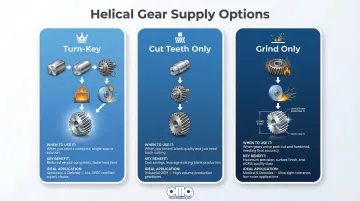
For aerospace, defense, and medical applications, custom gears with documented inspection records and full traceability are required regardless of cost premium. AS9100 mandates strict identification and traceability of outputs, including serial numbers and batch tracking back to raw material heat lots. Carnes-Miller Gear supports all three supply modes — turn-key, cut-only, and grind-only — with in-house nital-etch testing and AGMA 13 capability on ground gears.
Why Carnes-Miller Gear Is a Trusted Helical Gear Wholesale Manufacturer
Why Carnes-Miller Gear Is a Trusted Custom Helical Gear Manufacturer
Carnes-Miller Gear (CMG) is a U.S.-based precision gear manufacturer with over 50 years of experience since 1973. Operating from an 18,000-square-foot dedicated facility in Locust, NC, CMG has built its reputation on consistent quality, documented precision standards, and full in-house control — attributes OEM buyers depend on for long-term sourcing partnerships.
AGMA Quality Credentials
CMG achieves:
- AGMA 10 on shaped and hobbed gears
- AGMA 13 on ground spur and heat-treated gears
For buyers who need documented precision standards for engineering specifications, these ratings translate to ISO A2-A5 equivalent accuracy—suitable for aerospace, defense, medical, and high-speed industrial applications.
Full In-House Capability
CMG maintains complete in-house control over:
- Gear blanking
- Hobbing and shaping
- Milling
- Grinding (up to 400mm diameter)
- Broaching
This vertical integration means consistent quality, predictable lead times, and no dimensional variation from outsourced grinding or heat treatment.
Premium Service Differentiators
- Nital-etch inspection: CMG performs SAE AMS 2649 testing for grinding burns, verifying surface integrity before delivery
- Reverse engineering: For obsolete equipment or legacy applications without original drawings, CMG works from worn samples or partial specs to resolve costly sourcing gaps
Industries Served
CMG serves aerospace, defense, medical, industrial, mining, transportation, construction, agricultural, and rail sectors. This cross-industry experience means CMG understands the specific material grades, coatings, tolerance classes, and documentation requirements unique to each application.
To discuss custom helical gear requirements or request a quote:
- Phone: 704-888-4448 or 800-273-6814 (toll-free)
- Email: dan@cmgear.us
- Business Hours: Monday-Friday 8 AM-3:30 PM
Frequently Asked Questions
What is the difference between helical gears and spur gears?
Helical gears have angled teeth that engage gradually, distributing load across multiple teeth for smoother, quieter operation and higher load capacity. Spur gears have straight teeth that engage all at once — simpler and less expensive, but noisier under load and more prone to shock loading.
What AGMA rating do I need for industrial helical gears?
AGMA ratings 10–13 are standard for precision industrial applications, with higher numbers indicating finer tolerances and better surface finish. The right rating depends on your speed, load, and noise requirements — for reference, Carnes-Miller Gear achieves AGMA 10 on shaped and hobbed gears and AGMA 13 on ground gears.
Can helical gears be custom-manufactured to my specifications?
Yes. Custom helical gears can be manufactured to specific helix angles, modules, face widths, materials, and tolerance classes — working from engineering drawings or reverse-engineered from a sample part. This makes custom manufacturing practical for both OEM production and aftermarket replacement.
What industries use helical gears most commonly?
Aerospace, defense, mining, construction, transportation, agricultural, and industrial machinery sectors are the primary users. Their ability to handle high loads and high speeds quietly makes them a standard choice wherever reliability and service life are non-negotiable.
What is nital-etch testing and why does it matter for gear quality?
Nital-etch testing (SAE AMS 2649, ISO 14104) is a chemical inspection method that reveals grinding burns or surface damage caused during the grinding process. Undetected burns create soft spots or brittle rehardened layers that cause premature gear failure — making it critical for aerospace, defense, and high-performance work. Carnes-Miller Gear performs nital-etch testing in-house as part of its standard quality process.
How do I evaluate a helical gear wholesale manufacturer for long-term OEM supply?
Prioritize AGMA/ISO quality ratings, fully in-house production capabilities, heat treatment options, and a verifiable track record in your industry. Ask for documentation of inspection procedures and traceability systems — and confirm whether processes like grinding and testing are performed in-house or outsourced.