Introduction
Precision gears power the core systems in modern vehicles: transmissions, differentials, steering assemblies, and electric drivetrains. As vehicle electrification advances and efficiency requirements tighten, precision gearing has become critical for OEMs competing on performance and reliability.
Today's automotive OEMs face a challenging supplier landscape: extended lead times, inconsistent quality from overseas sources, and difficulty finding shops that handle both standard specs and reverse-engineered legacy components.
The right gear manufacturer delivers AGMA-rated precision, manages custom specifications, supports reverse engineering for obsolete systems, and maintains certifications for high-performance and defense vehicle applications. Selecting a supplier isn't just about cost—it requires a partner with technical depth, quality discipline, and the flexibility to handle specialized custom work.
Key Takeaways
- Manufacturers supply critical gears for powertrains, transmissions, and drivetrains across passenger, commercial, and specialty vehicles
- Leading suppliers offer AGMA-rated quality, full-service production (blanking to grinding), and custom/reverse engineering
- Choose based on precision tolerances, material expertise, application experience, and supply chain strategy
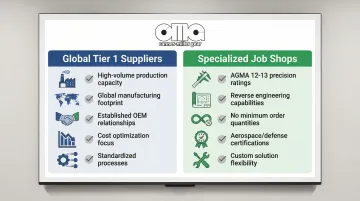
- Options range from global Tier 1 suppliers to specialized job shops focused on aerospace, defense, and performance automotive
Overview of Automotive Gear Manufacturers in the Automotive Engineering Sector
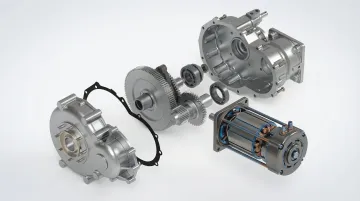
Automotive gear manufacturers design and produce spur, helical, bevel, worm, and specialty gears for transmissions, differentials, steering systems, and transfer cases. Electric vehicle reduction gears represent the fastest-growing application segment.
The industry is shifting toward tighter precision and customization as automotive engineering demands increase. EV applications require gears operating at speeds exceeding 15,000 RPM, where noise, vibration, and harshness (NVH) performance becomes critical without an internal combustion engine to mask gear whine.
The global automotive gears market was valued at approximately USD 42.7 billion in 2024 and is projected to reach USD 50.8 billion by 2030, growing at a CAGR of 3.0% according to MarketsandMarkets research.
Key drivers include:
- Vehicle electrification and EV powertrain development
- Fuel efficiency regulations pushing advanced transmission designs
- Growth in SUV and commercial vehicle segments
- Increasing comfort features requiring precision gear systems
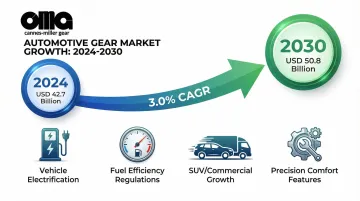
This growth creates demand for manufacturers with both volume capacity and specialized capabilities. The manufacturers profiled below represent a strategic mix of global leaders and specialized suppliers, selected for their technical capabilities, industry reach, and ability to serve diverse automotive engineering requirements—from high-volume OEM production to low-volume custom and aftermarket applications.
Top Automotive Gear Manufacturers for Automotive Engineering
These manufacturers were chosen based on key criteria including manufacturing capabilities, precision quality ratings (AGMA standards), industry certifications, and sector experience.
Additional factors include breadth of gear types offered and reputation for reliability and technical support.
American Axle & Manufacturing Holdings, Inc.
American Axle (US-based, founded 1994) is a Tier 1 automotive supplier specializing in driveline and metal forming, with strong focus on ring and pinion gears, differential assemblies, and transmission components.
The company invested $155.4 million in R&D in 2023 (2.5% of revenue), emphasizing development of solutions for both ICE and electric/hybrid vehicle platforms.
Key differentiators include:
- Extensive global manufacturing footprint (80+ facilities in 18 countries)
- Major OEM relationships with GM, Stellantis, and Ford
- Vertically integrated metal forming capabilities
- Commitment to emerging technologies like lightweight materials and electrification-ready gear systems
- Recent contracts for e-Beam axles for future Stellantis EV programs
| Aspect | Details |
|---|---|
| Key Capabilities | Driveline gears (ring & pinion, differential, axle gears), metal forming, heat treatment; serves passenger cars, light trucks, SUVs, commercial vehicles |
| Notable Strengths | Tier 1 supplier status, global manufacturing scale, strong R&D investment, OEM partnerships with Detroit Big Three, electrification technology development |
| Target Applications | Automotive transmissions, differential assemblies, axle systems, electric drive units for hybrid and EV platforms |
GKN Automotive Limited (Dowlais Group)
GKN Automotive (UK heritage, now part of Dowlais Group post-2023 demerger) is a global leader in driveline and ePowertrain solutions, with deep expertise in precision gears for all-wheel drive systems, constant velocity joints, and electric drive units. Their advanced R&D center in the UK (opened 2021) focuses exclusively on next-generation eDrive systems.
Competitive advantages include:
- Pioneering role in electric vehicle gear technology
- Mechatronic integration capabilities
- Lightweight design expertise for efficiency gains
- Presence across Americas, Europe, and Asia Pacific with localized engineering support
GKN was awarded a contract for a full 3-in-1 eDrive system (front and rear) for a high-performance electric SUV, with their first in-house designed system entering production in 2024.
| Aspect | Details |
|---|---|
| Key Capabilities | Precision drivetrain gears, eDrive gears, differential gears, all-wheel drive components; advanced powder metallurgy processes |
| Notable Strengths | Global ePowertrain technology leader, dedicated eDrive R&D facility, mechatronic system integration, lightweight/high-efficiency gear design |
| Target Applications | Electric and hybrid vehicle drive units, all-wheel drive systems, automotive driveline components, high-performance passenger vehicles |
Bharat Gears Limited
Bharat Gears (India, founded 1971) is India's largest gear manufacturer with massive production capacity: over 1 million spiral bevel ring and pinion sets, 7.5 million transmission gears, and 1 million differential gears annually.
They operate three manufacturing plants in India and export to Europe, US, Mexico, and Asia.
Notable strengths:
- Unmatched production scale in the Asian market
- Diverse customer base spanning on-highway OEMs (Ashok Leyland, Tata Motors, Toyota Kirloskar)
- Serves off-highway equipment makers including JCB, John Deere, and Mahindra
- Strong cost competitiveness with focus on both OEM and aftermarket segments
| Aspect | Details |
|---|---|
| Key Capabilities | Spiral bevel gears, transmission gears, differential gears, heat treatment; high-volume manufacturing for automotive and off-highway sectors |
| Notable Strengths | Largest gear manufacturer in India, massive annual production capacity, established OEM relationships, export capabilities to North America/Europe/Asia |
| Target Applications | Commercial vehicle transmissions and differentials, agricultural machinery gears, construction equipment, automotive aftermarket replacement parts |
JTEKT Corporation
JTEKT (Japan, founded 1921 as Koyo Seiko, merged 2006) is a Toyota Group company and global automotive systems supplier, with a dedicated Gear Innovation Center advancing gear accuracy and performance.
In September 2022, they expanded into a standalone gears and capacitors business division, reflecting strategic commitment to gear technology.
Core advantages include:
- Deep integration with Toyota's quality standards and global supply chain
- Comprehensive gear portfolio (bevel, cylindrical, worm gears) with high-strength and high-precision variants
- Significant R&D investment (2.9% of revenue in 2023)
- Operations in 151 countries supporting both automotive steering and powertrain applications
| Aspect | Details |
|---|---|
| Key Capabilities | Bevel gears, cylindrical gears, worm gears, steering gears; precision machining, heat treatment, gear accuracy R&D through Innovation Center |
| Notable Strengths | Toyota Group heritage and quality standards, global presence (151 countries), dedicated Gear Innovation Center, R&D investment focus, automotive steering expertise |
| Target Applications | Automotive steering systems, transmission gears, differential components, electric power steering modules, precision automotive assemblies |
Carnes-Miller Gear Co., Inc.
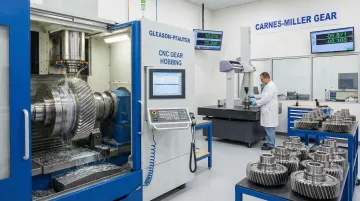
Carnes-Miller Gear (US, founded 1973 in Locust, NC) is a specialized full-service job shop with over 50 years of precision gear manufacturing experience, offering comprehensive in-house capabilities from gear blanking and hobbing through grinding and broaching in an 18,000 sq ft dedicated facility. They serve aerospace, defense, medical, rail, and high-performance automotive applications where precision and traceability are critical.
Distinctive capabilities include:
- AGMA 10 quality rating on shaped/hobbed gears and AGMA 13 on ground/heat-treated gears (among the highest industry standards)
- Reverse engineering capabilities for obsolete automotive and industrial components
- In-house nital-etch testing for grinding burns
- No minimum order quantities supporting both prototype and production runs
- 50-year track record of reliability through multiple economic cycles
| Aspect | Details |
|---|---|
| Key Capabilities | Spur, helical, bevel, worm gears; gear blanking, shaping, hobbing, grinding, broaching; reverse engineering; in-house heat treatment and nital-etch testing |
| Notable Strengths | AGMA 10 (shaped/hobbed) and AGMA 13 (ground) quality ratings, full-service job shop, reverse engineering for obsolete parts, aerospace/defense/medical sector experience, 50+ years in business |
| Target Applications | Aerospace automotive components, defense vehicle gears, medical device precision gears, high-performance automotive transmissions, industrial machinery, aftermarket/replacement parts |
How We Chose the Best Automotive Gear Manufacturers
Common buyer mistakes include focusing solely on price without considering AGMA quality ratings, overlooking certifications critical for aerospace-adjacent automotive work, choosing suppliers without reverse engineering capabilities when dealing with legacy systems, or selecting high-volume manufacturers unable to support small custom batches.
The "best" manufacturer depends entirely on your application requirements, volume, and precision needs. We evaluated suppliers across five key criteria that directly impact automotive engineering outcomes.
Evaluation Factors
AGMA Quality Ratings & Precision Tolerances
Critical for transmission and differential applications. Higher AGMA ratings (12-13) are essential for EV reduction gears operating at high speeds where NVH (noise, vibration, and harshness) performance is critical.
Manufacturing Breadth
Full-service capabilities from blanking to grinding improve quality control and reduce lead times by eliminating handoffs between suppliers.
Industry Certifications & Sector Experience
Aerospace, defense, and medical certifications signal process discipline and traceability valuable in high-reliability automotive applications. IATF 16949 is non-negotiable for automotive supply chains.
Reverse Engineering & Custom Capabilities
Essential for aftermarket opportunities, legacy system support, and specialty applications where original tooling or drawings are unavailable.
Supply Chain Considerations
Domestic manufacturing with no minimum order quantities provides supply chain resilience and flexibility for R&D and low-volume specialty vehicle programs. Global footprints offer cost advantages and regional support.
Conclusion
The automotive gear manufacturing landscape includes both global Tier 1 suppliers serving high-volume OEM production and specialized job shops delivering precision custom solutions. The right partner depends on your application requirements, volume, quality standards, and whether you need capabilities like reverse engineering or aerospace-grade certifications.
When evaluating suppliers, look beyond brand reputation to assess practical capabilities:
- AGMA quality ratings relevant to your application (AGMA 10 for hobbed gears, AGMA 13+ for precision ground gears)
- In-house manufacturing capabilities vs. outsourced processes
- Sector-specific certifications for aerospace, defense, or medical automotive applications
- Reverse engineering support for legacy components and obsolete equipment
- Minimum order quantities and lead times for both prototype and production phases
For automotive engineering applications requiring precision gears with AGMA 13 quality ratings, full-service in-house manufacturing, and reverse engineering capabilities, contact Carnes-Miller Gear.
With over 50 years of experience serving aerospace, defense, and specialty automotive sectors from their Locust, NC facility, they offer the technical expertise and flexibility to support both prototype development and production runs. Reach them at 704-888-4448 or dan@cmgear.us.
Frequently Asked Questions
What AGMA quality ratings should I look for in automotive gears?
AGMA ratings range from 5-15, with higher numbers indicating tighter tolerances. Automotive transmission gears typically require AGMA 10-11 minimum, while high-performance or electric vehicle applications often need AGMA 12-13, which require grinding and heat treatment.
What's the difference between hobbed and ground gears for automotive applications?
Hobbing is a cost-effective cutting process suitable for AGMA 8-10 quality and moderate precision needs. Grinding achieves AGMA 11-13 quality with superior surface finish and tighter tolerances, making it ideal for high-load or high-speed applications like transmissions and differentials.
How do I choose between standard and custom automotive gears?
Standard gears work for common ratios with faster delivery and lower cost. Custom gears become necessary when space constraints, unique ratios, special materials, or integration requirements exist. Most automotive applications require custom solutions due to packaging constraints and performance optimization.
What industries besides automotive use precision gear manufacturers?
Precision gear manufacturers serve aerospace, defense, medical devices, industrial machinery, rail systems, and mining equipment. Suppliers with these diverse capabilities bring higher quality standards and manufacturing discipline to automotive applications.
What certifications matter most when selecting an automotive gear manufacturer?
ISO 9001 is baseline, while AS9100 (aerospace) or ISO 13485 (medical) indicate process discipline for high-reliability applications. ITAR registration matters for defense vehicles. In-house testing capabilities like nital-etch for grinding burns demonstrate quality commitment beyond certifications.
Can gear manufacturers reverse engineer obsolete automotive components?
Specialized manufacturers use CMM inspection and gear measurement to recreate specifications from worn or undocumented parts. This capability is critical for aftermarket suppliers, restoration projects, and legacy vehicle support when original tooling is unavailable.