Introduction
When critical machinery fails mid-production, the costs multiply fast. Downtime, scrapped parts, missed deadlines, and emergency repairs can erase months of operational gains. For manufacturers in aerospace, medical devices, heavy industry, and transportation, gear performance directly determines whether you meet increasing demands for precision, efficiency, and uptime.
Engineers often focus on mechanical specifications—tooth geometry, ratios, materials. But the real business value appears in measurable outcomes: equipment availability, maintenance intervals, energy consumption per unit, and product quality consistency.
This article examines how gears transform machine performance across power transmission, precision control, and operational efficiency, with practical insights for specifying custom gear solutions.
Key Takeaways
- Multiply torque and control speed ratios to deliver high force without larger motors
- Eliminate slippage for exact synchronization in quality and safety-critical systems
- Achieve 95-99% mechanical efficiency with decades of operational life under proper maintenance
- Direct impact on energy costs, uptime, maintenance intervals, and product quality
What Is a Gear (Brief Context)
Gears are toothed mechanical components that mesh to transmit rotational motion, torque, and power between machine shafts with a precise, predictable relationship. Unlike belt or friction drives, gears provide positive engagement—no slippage, no timing drift.
They are applied wherever machines need reliable speed conversion, direction changes, torque multiplication, or synchronized motion:
- Automotive transmissions requiring precise gear ratios
- Industrial gearboxes handling high-torque applications
- Precision medical equipment where positioning accuracy affects patient outcomes
- Aerospace systems demanding zero-slippage power transmission
Key Advantages of Gears
The advantages below focus on measurable operational and business impacts rather than abstract mechanical theory. Each ties directly to outcomes industrial operations track: equipment reliability, energy efficiency, maintenance costs, precision output, and total cost of ownership.
Understanding these advantages helps procurement and engineering teams make gear specification decisions that affect long-term operational performance, not just component purchase price.
Advantage 1: Mechanical Advantage – Torque Multiplication and Speed Control
Gears provide mechanical advantage by trading speed for torque or vice versa, enabling machines to multiply force output or achieve required operating speeds without changing motor or engine size.
Different gear ratios—based on tooth count differences between meshing gears—allow a single power source to drive multiple operational modes: high torque for heavy starting loads, high speed for rapid throughput.
Operational Impact:
Torque multiplication reduces the need for oversized, expensive motors and enables compact equipment designs that still deliver high force output.
In a mining conveyor application, upgrading from an undersized 10:1 ratio that caused frequent motor burnouts to a properly sized 25:1 helical gearbox allowed reliable operation for 7 years with minimal maintenance.
Gear ratios enable machines to operate in optimal efficiency zones across varying load conditions, reducing energy waste and component stress. Integrating Variable Frequency Drives with optimized gear ratios delivered energy savings exceeding 28% in one industrial facility, with payback in approximately 1 year.
When motors run at their most efficient speeds while gears handle the speed/torque conversion, total system efficiency improves dramatically.
Permanent Magnet motors paired with optimized gear ratios achieve 92-96% efficiency versus 85-90% for standard AC induction motors—reducing energy losses by up to 50% and allowing smaller motor selections.
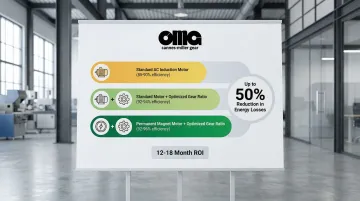
High-efficiency motors require 15-20% higher upfront investment, but energy and maintenance savings offset this cost in 12-18 months.
KPIs impacted:
- Capital equipment cost (smaller motors, compact footprint)
- Energy consumption (kWh per unit produced)
- Throughput rates (speed control flexibility)
- Equipment footprint (space-constrained installations)
When this advantage matters most:
- Heavy-duty industrial applications requiring high starting torque
- Variable-load operations needing multiple speed ranges
- Space-constrained installations (aerospace, medical devices)
- Applications where maintaining motor efficiency zones is critical for energy management
Advantage 2: Precision and Reliability – Consistent Power Transmission
Beyond power multiplication, gears deliver another critical advantage: positive engagement with zero slippage. This differs from belt or friction drives, delivering exact speed ratios and synchronized motion critical for precision manufacturing and safety-critical systems.
Gear tooth geometry and precision grades determine positioning accuracy, repeatability, backlash control, and smooth operation.
AGMA precision standards define 13 quality classes, with higher numbers indicating tighter tolerances. AGMA Q14-15 gears are critical for applications requiring minimal transmission error and high load capacity. Manufacturers like Carnes-Miller Gear achieve AGMA 13 ratings on ground gears for applications demanding highest precision across aerospace, defense, and medical sectors.
Performance Benefits:
Positive engagement eliminates the timing drift and slippage inherent in belt and chain systems, maintaining exact synchronization in multi-axis equipment, assembly lines, and safety systems.
In industrial robots, gear backlash is a primary source of positioning error—using backlash compensation reduced mean position error by over 90% (from 1.0751 mm to 0.1008 mm) and standard deviation by over 84%.
Precision grinding and heat treatment processes reduce noise, vibration, and wear while extending service life. NASA research confirmed that superfinished gears achieve a fourfold service life compared to conventionally ground gears, with a 15% reduction in friction and 4°C lower operating temperature. Ground gears achieve AGMA grades 12-13+, while cut-only gears generally reach AGMA 8-10.
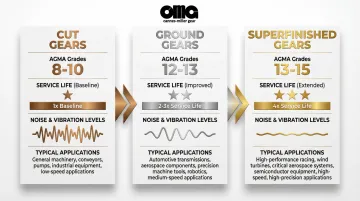
Precision directly affects quality outcomes: reduced product defects, tighter tolerances, consistent cycle times, and predictable maintenance intervals. In aerospace manufacturing, a 1% dip in first-pass yield can cost millions in rework—precision gears help maintain the tight tolerances that prevent such losses.
KPIs impacted:
- Product quality and defect rates
- Equipment uptime percentage
- Maintenance frequency and costs
- Positioning accuracy (microns)
- Noise levels (dB) and vibration (worker safety/comfort)
When this advantage matters most:
- Aerospace and defense systems requiring zero-failure reliability
- Medical devices where precision affects patient outcomes
- Automated manufacturing with tight tolerance requirements
- High-speed operations where vibration causes accelerated wear
- Multi-machine synchronized systems where timing drift creates quality problems
Advantage 3: Efficiency and Durability – Long-Term Cost Performance
Well-designed gear systems achieve 95-99% mechanical efficiency—minimal energy loss to friction and heat—and can operate for decades with proper lubrication. This contrasts with friction drives or hydraulic systems requiring frequent replacement. Modern helical and bevel gear units lose only about 1.5% efficiency per stage, with two-stage units commonly achieving ~97% efficiency. Worm gears range from 50-90% efficiency depending on ratio and operating conditions.
Factors like gear material selection, heat treatment, surface finish, and lubrication design determine efficiency and wear resistance. With proper maintenance, industrial gearboxes often outlast belt drives (2-5 year lifespan) and chain drives (3-8 year lifespan) by decades.
Financial Impact:
High efficiency translates directly to reduced energy costs over equipment lifetime. For a 100 HP (74.6 kW) industrial gearbox running 24/7 at $0.0815 per kWh (average U.S. industrial rate), upgrading from 92% to 98% efficiency saves over $3,500 annually per unit. For facilities with multiple units, this represents massive total cost of ownership reduction.
| Efficiency Level | Annual Energy Cost | Annual Savings vs. 92% |
|---|---|---|
| 92% (Standard) | $57,895 | - |
| 96% (High) | $55,483 | $2,412 |
| 98% (Precision) | $54,351 | $3,544 |

Durability reduces total cost of ownership through extended replacement intervals, reduced downtime for maintenance, and lower spare parts inventory requirements. Gear systems maintain efficiency over time—while belts tend to stretch and hydraulics develop leaks—providing predictable operating costs and stable performance throughout their service life.
KPIs impacted:
- Energy consumption (kWh per operating hour)
- Maintenance costs (labor plus parts)
- Equipment downtime hours
- Mean time between failures (MTBF)
- Total cost of ownership (TCO)
When this advantage matters most:
- Continuous-duty industrial operations where energy costs dominate
- Remote installations where maintenance access is difficult or expensive
- Harsh environments (temperature extremes, contamination) requiring robust components
- Capital-intensive equipment where downtime costs are severe
What Happens When Gears Are Missing or Poorly Specified
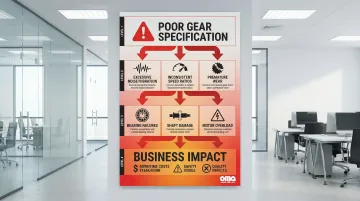
Using inadequate gear quality or inappropriate gear types creates measurable consequences that affect both operations and finances. These issues typically manifest in three critical areas.
Inconsistent Performance and Quality Issues
Inconsistent speed ratios and torque delivery lead to variable product quality, process instability, and inability to maintain tight tolerances in precision applications.
When gears cannot maintain exact speed relationships, downstream processes receive inconsistent inputs, creating defects and rework.
Premature Failure and Cascading Damage
Premature wear and failure from incorrect material selection, inadequate heat treatment, or improper gear geometry result in unexpected downtime and emergency repairs.
The average cost of downtime is approximately $164,000 per hour, with 35% of small and medium businesses losing as much as $500,000 from single downtime events.
Gearbox failures often transmit shock loads to motors and driven equipment, causing secondary damage to shafts and bearings that compounds repair costs.
Operational Disruption and Safety Concerns
Excessive noise and vibration from poor tooth contact or misalignment create worker discomfort and accelerate bearing failures. OSHA requires hearing conservation programs when noise exposure equals or exceeds 85 dBA and engineering controls above 90 dBA.
High vibration levels damage equipment and can indicate developing problems before catastrophic failure. This makes proper gear specification a safety issue as well as a performance concern.
How to Get the Most Value from Gears
Gear performance depends on proper specification, correct installation, and consistent maintenance. Each element affects whether gears deliver their full operational and financial benefits.
Specify gears based on application requirements:
Match AGMA precision grades to your tolerance needs:
- AGMA 10-11 for general industrial use
- AGMA 12-13 for precision applications requiring low noise and tight tolerances
- AGMA 13-15 for aerospace, medical, and critical applications where failure is unacceptable
Select gear types (spur, helical, bevel, worm) based on shaft orientation and load characteristics. Consider material and heat treatment for the operating environment.

Getting these specifications right from the start prevents costly mistakes down the line. Experienced manufacturers like Carnes-Miller Gear offer engineering support for custom applications across aerospace, medical, and industrial sectors, with capabilities including gear grinding up to 400mm diameter and achieving AGMA 13 ratings on ground gears.
Their 50 years of experience helps customers navigate specification decisions that affect long-term performance.
Implement proper installation and maintenance practices:
Ensure accurate shaft alignment within manufacturer specifications. Misalignment reduces load-carrying capacity and causes non-uniform load distribution leading to premature failure.
Use recommended lubricants and change intervals. For synthetic oils, change intervals typically extend to 5 years, depending on operating conditions.
Establish inspection schedules to catch wear before failure:
- Check running noise for bearing damage every 3,000 operating hours or at least every 6 months
- Track gear tooth contact patterns and backlash measurements
- Monitor vibration levels regularly
This documentation enables data-driven replacement decisions rather than reactive emergency repairs.
Conclusion
The advantages of gears—mechanical advantage, precision, efficiency, and durability—deliver measurable business value through reduced energy costs, improved product quality, and extended equipment life.
These benefits compound over equipment lifetime when you properly specify gears for the application and maintain them according to manufacturer recommendations.
Treat gear selection as a strategic decision affecting long-term operational performance, not just a component purchase. Key considerations include:
- Matching gear specifications to actual application demands
- Accessing engineering expertise for complex requirements
- Ensuring manufacturing capabilities support precision tolerances
- Planning for predictable maintenance cycles
Partnering with a full-service job shop like Carnes-Miller Gear—with 50 years of experience and complete in-house capabilities—ensures optimal specifications for aerospace, defense, medical, and industrial applications requiring AGMA 10-13 ratings.
Frequently Asked Questions
What are three things gears are used for?
Gears are used to (1) multiply torque for heavy-load applications like conveyors and lifting equipment, (2) change rotational speed to match process requirements such as high-speed machining or slow mixing operations, and (3) change the direction of rotational motion between non-parallel shafts in complex machinery layouts.
What are three machines that use gears?
Automotive transmissions use gears for speed and torque conversion to match driving conditions. Industrial gearboxes and reducers transmit power in manufacturing equipment. Precision machines like CNC equipment and medical devices use gears for accurate positioning and motion control where micron-level accuracy is required.
How do I choose the right gear precision grade for my application?
Select AGMA 10-11 for general industrial use, AGMA 12-13 for precision applications requiring low noise and tight tolerances, and AGMA 13-15 for aerospace, medical, and critical applications where positioning accuracy is paramount.
What factors affect gear lifespan and when should gears be replaced?
Gear life depends on load cycles, lubrication quality, and operating environment. Replace when backlash exceeds specifications, noise or vibration increase significantly, or inspection reveals pitting, scoring, or surface damage during scheduled maintenance.
Can worn or damaged gears be repaired or must they be replaced?
Minor damage can be addressed through re-grinding or re-machining if sufficient material remains. Heat-treat distortion or significant wear typically requires replacement, with reverse engineering services available to reproduce obsolete gears when original specifications are unavailable.
What's the difference between cut gears and ground gears in terms of performance?
Ground gears achieve higher precision grades (AGMA 12-13+), lower noise, and smoother operation compared to cut-only gears (AGMA 8-10). Research shows ground gears can achieve four times the service life, making grinding essential for high-speed or noise-sensitive applications.