Introduction
Selecting between helical and spur gears determines whether your equipment runs quietly or generates excessive noise, whether gears fail prematurely or deliver decades of service, and whether maintenance costs remain manageable or spiral out of control.
The design differences between these two gear types create dramatically different performance profiles. Helical gears feature angled teeth that engage gradually, while spur gears use straight teeth that mesh abruptly.
This comparison examines how tooth geometry affects noise levels, load capacity, efficiency, cost, and application suitability—helping engineers and procurement managers match gear type to operational requirements. We'll cover performance characteristics, manufacturing considerations, and practical selection criteria for aerospace, defense, medical, and industrial applications.
Key Takeaways
- Spur gears have straight teeth; helical gears use angled teeth (15-30° helix)
- Helical gears deliver 10-20 dB quieter operation and 50% higher load capacity but cost 30-40% more
- Spur gears achieve 98-99% efficiency with no axial thrust; helical gears reach 95-98% efficiency due to sliding friction
- Choose spur for <1,000 RPM and tight budgets; helical for >3,000 RPM and quiet operation
- Match gear type to your speed requirements and noise tolerance for optimal performance
Helical Gears vs Spur Gears: Quick Comparison
Understanding the core differences between helical and spur gears helps you select the right gear type for your application. The table below compares these two common gear designs across six critical performance factors.
| Feature | Spur Gears | Helical Gears |
|---|---|---|
| Tooth Design | Straight teeth parallel to axis | Angled teeth (15-30° helix) |
| Noise & Vibration | High (impact noise at speed) | Low (10-20 dB quieter) |
| Load Capacity | Moderate (contact ratio 1.2-1.6) | High (contact ratio >2.0, ~50% higher capacity) |
| Efficiency | 98-99% (no axial thrust) | 95-98% (sliding friction + axial thrust) |
| Manufacturing Cost | Baseline | 30-40% higher |
| Typical Applications | Conveyor systems, gear pumps, printing presses, low-speed machinery | Automotive transmissions, aerospace systems, high-speed equipment, medical devices |
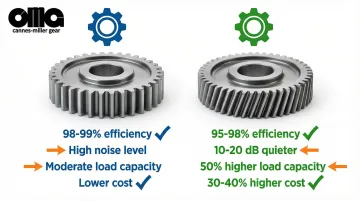
The choice between these gear types ultimately depends on your specific requirements for noise, load capacity, efficiency, and budget. For applications requiring quiet operation and high load capacity, helical gears justify their higher cost.
What is a Spur Gear?
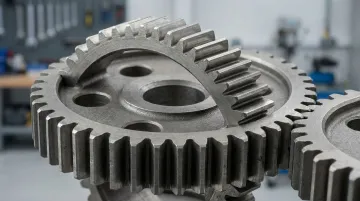
Spur gears are the simplest and most common gear type, featuring teeth cut straight and parallel to the gear axis. Their cylindrical or disk shape creates a straightforward mesh pattern where one tooth engages at a time in full, immediate contact.
This straightforward design delivers several operational advantages:
- High efficiency: 98-99% power transmission due to pure rolling contact with no axial thrust
- Cost-effective manufacturing: Simple hobbing or shaping processes reduce production costs by 30-40% compared to helical gears
- Simple maintenance: Standard radial bearings work well; no thrust bearing complexity
- Wide availability: Offered in diverse materials, sizes, and quality grades
Key limitation: Because teeth engage with full immediate contact along the entire tooth width, spur gears generate substantial noise and vibration—especially at speeds above 1,000 RPM.
This line-contact engagement creates characteristic whining sounds and subjects individual teeth to higher shock loading, potentially reducing service life in demanding applications.
Use Cases of Spur Gears
Spur gears fit industrial applications where cost-effectiveness and efficiency outweigh noise concerns:
Primary applications:
- Low to moderate speed systems (typically under 3,600 RPM, optimal below 1,000 RPM)
- Gear pumps requiring precision ground gears (often AGMA Q8 or higher)
- Conveyor systems and material handling equipment
- Printing presses and packaging machinery
- Timing mechanisms and feed mixers
Dominant industries:
- Industrial machinery and general manufacturing
- Material handling and logistics equipment
- Agricultural equipment and outdoor machinery
- Parallel shaft power transmission with budget constraints
Industry data shows spur gears achieve efficiency ratings of 98-99.5%, making them ideal for energy-sensitive systems where every efficiency point matters.
What is a Helical Gear?
Helical gears represent an advanced gear type with teeth cut at an angle—called the helix angle, typically 15-30 degrees—to the gear axis.
This angled tooth design creates gradual engagement that distinguishes them from spur gears, delivering both significant benefits and unique engineering challenges.
Operational benefits:
- Gradual tooth engagement reduces noise by 10-20 dB compared to spur gears at similar speeds
- Multiple teeth share loads simultaneously (contact ratio often exceeds 2.0), increasing capacity by approximately 50%
- Gradual engagement minimizes vibration and shock loading at high speeds
- Supports both parallel and non-parallel shaft arrangements
Key limitation: The angled teeth create axial thrust forces requiring thrust bearings or tapered roller bearings. This reduces overall efficiency to 95-98% compared to spur gears and adds complexity to bearing selection, mounting, and housing design.
Common Helical Gear Configurations
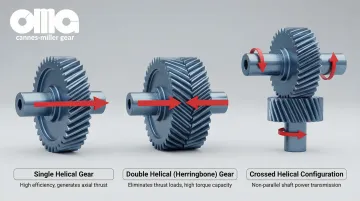
- Single helical: Most common configuration for general industrial use
- Double helical (herringbone): Two opposing helix angles cancel axial thrust but increase manufacturing complexity
- Crossed helical: Enables power transmission between non-parallel, non-intersecting shafts
These variations allow engineers to select the optimal configuration for specific load, speed, and shaft arrangement requirements.
Use Cases of Helical Gears
Helical gears excel in applications demanding smooth, quiet operation under high loads or speeds:
Typical applications:
- High-speed systems (above 3,600 RPM, with some aerospace applications reaching 15,000 RPM)
- Heavy-duty load transmission requiring extended service life
- Automotive transmissions where noise reduction is critical
- Medical equipment and precision robotics requiring minimal vibration
- Any application with strict noise compliance requirements (<75 dB)
Key industries:
- Aerospace systems and defense applications
- Automotive manufacturing and transmission production
- Medical device production requiring quiet operation
- High-precision robotics and automation
- Industrial gearboxes for heavy machinery
Research shows that helical gears reduce operational noise by 10-15 dB at standard speeds (1,000-3,000 RPM) and up to 20 dB at speeds exceeding 3,000 RPM compared to spur gears in equivalent applications. This dramatic acoustic improvement makes them essential where noise complaints, regulatory compliance, or operator comfort are priorities.
Helical Gears vs Spur Gears: What is Better?
Neither gear type is universally "better"—the optimal choice depends on specific application requirements. Engineers should evaluate these key factors:
Decision criteria:
- Operational speed requirements and duty cycles
- Acceptable noise and vibration levels
- Load and torque demands
- Shaft configuration (parallel vs. non-parallel)
- Space constraints for bearings and housings
- Manufacturing budget and total cost of ownership
- Maintenance access and complexity
Efficiency and Power Transmission
Spur gears achieve higher efficiency (98-99%) because they produce only radial loads with no axial thrust, creating pure rolling contact between teeth.
Helical gears sacrifice 1-3% efficiency due to axial thrust forces and sliding friction along the angled tooth surfaces.
When efficiency differences matter: For battery-operated mechanisms, continuous-duty industrial drives, or systems where energy costs accumulate over 10+ year lifecycles, the 1.5% efficiency advantage of spur gears can translate to thousands of dollars in operational savings.
Noise, Vibration, and Operational Smoothness
Helical gears' gradual tooth engagement creates significantly quieter operation, making them essential for medical, aerospace, and consumer-facing applications.
The angled teeth engage progressively rather than with immediate full contact. This distributes impact forces over time and reduces characteristic gear whine.
Spur gears' immediate full-tooth contact creates impact loading that generates noise, especially at speeds above 1,000 RPM. This makes them unsuitable for noise-sensitive environments despite their other advantages.
Load Capacity and Durability
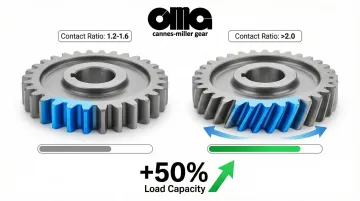
Helical gears handle approximately 50% higher loads than comparably sized spur gears due to their higher contact ratio (>2.0 vs. 1.2-1.6). Multiple teeth share the load simultaneously, reducing individual tooth stress and extending service life under demanding conditions.
This capacity advantage allows engineers to specify smaller helical gears for the same torque requirements, potentially downsizing the entire gearbox and offsetting some of the initial cost premium.
Manufacturing Complexity and Cost
Manufacturing complexity differs significantly:
- Spur gears: Simple two-dimensional cutting using basic hobbing or shaping processes
- Helical gears: Sophisticated three-dimensional cutting with precise helix angle control
- Cost impact: Helical gears typically cost 30-40% more to manufacture
Beyond the gear itself, helical systems require thrust bearings and stronger housings to manage axial loads, further increasing total system cost.
Decision Framework
Choose spur gears when:
- Operating speeds remain below 1,000 RPM
- Noise and vibration are acceptable trade-offs
- Budget constraints are primary drivers (30-40% cost savings)
- Maximum efficiency (99%+) is required for energy-sensitive applications
- Axial space is limited and thrust bearings cannot be accommodated
- Simple maintenance with standard radial bearings is preferred
Choose helical gears when:
- Operating speeds exceed 1,000 RPM (mandatory above 3,000 RPM)
- Noise reduction of 10-20 dB is required for compliance or comfort
- High load capacity and shock resistance are needed
- Smooth, vibration-free power transmission affects product quality
- Non-parallel shaft configurations are required
- Extended service life justifies higher initial investment
Real World Examples and Applications
Typical Selection Scenario
An OEM manufacturer designing a new industrial gearbox faces competing pressures: noise constraints from end-user environments, load requirements from application duty cycles, and cost targets from competitive pricing pressures.
The decision-making process considers:
- Operating speed: Will the gearbox run continuously at 2,500 RPM or intermittently at 800 RPM?
- Duty cycle: 24/7 operation demands different reliability margins than 8-hour shifts
- Ambient noise restrictions: Medical facilities require <75 dB; outdoor conveyors tolerate >85 dB
- Maintenance access: Remote installations favor simpler bearing configurations
- Total cost of ownership: Initial purchase price vs. energy costs, maintenance intervals, and expected service life
Carnes-Miller's Application Expertise
With over 50 years of precision gear manufacturing experience, Carnes-Miller Gear helps engineers balance these factors during the design phase. Our team provides consultation on gear selection for aerospace, defense, medical, and industrial applications—achieving AGMA 10 ratings on shaped and hobbed gears and AGMA 13 ratings on ground gears.
Whether you're designing a new system or replacing obsolete gears, our engineering team can help you select and manufacture the optimal solution. Contact us at 704-888-4448 to discuss your requirements.
Conclusion
After comparing these two gear types, one conclusion becomes clear: there is no universal "winner." The optimal choice depends entirely on your specific application context, including speed, load, noise constraints, shaft configuration, and budget.
Understanding these trade-offs enables engineers to make informed decisions that optimize performance, longevity, and cost-effectiveness:
When to choose spur gears:
- Reduce component costs by 30-40%
- Maximize power transmission efficiency for moderate-speed applications
- Ideal for cost-sensitive projects where noise is acceptable
When to choose helical gears:
- Extend equipment service life in demanding environments
- Reduce noise complaints by 10-20 dB
- Enable higher-speed operation where smooth, quiet transmission justifies the investment
Whether your application requires spur or helical gears, custom manufacturing ensures precise specifications. With over 50 years of experience grinding, cutting, and fabricating both gear types, precision job shops can deliver the exact performance characteristics your system demands.
Frequently Asked Questions
Which is better, spur or helical gear?
Neither is universally "better." Spur gears excel in cost-effectiveness and efficiency (98-99%) for moderate speeds below 1,000 RPM. Helical gears are superior for high-speed (>3,000 RPM), high-load, or noise-sensitive applications. The best choice depends on your specific speed, load, noise, and budget requirements.
Are helical gears quieter than spur gears?
Yes, helical gears are significantly quieter—typically 10-20 dB lower than spur gears at equivalent speeds. Their angled teeth engage gradually rather than with immediate full contact, reducing vibration and noise generation.
Are helical gears more expensive than spur gears?
Yes, helical gears typically cost 30-40% more due to complex three-dimensional cutting processes and tighter tolerances. They also require thrust bearings to manage axial loads, increasing total system cost beyond the spur gear's simpler radial bearings.
Is a helical gear a spur gear?
No, they're distinct gear types with different tooth orientations. Spur gears have straight teeth parallel to the axis, while helical gears have angled teeth. This design difference creates entirely different performance characteristics in efficiency, noise, and load capacity.