
Introduction
Helical and bevel gears serve distinct power transmission needs in industrial manufacturing. Helical gears feature angled teeth on cylindrical bodies for parallel-shaft applications, while bevel gears use conical geometries to transmit power between intersecting shafts—typically at 90-degree angles.
Your choice between these gear types directly impacts equipment efficiency, workplace noise levels, maintenance costs, load capacity, and system reliability.
The global gear market is projected to reach $294.03 billion by 2030 (growing at 5.77% CAGR). This growth reflects how critical proper gear selection is for industrial operations.
For manufacturers in aerospace, defense, mining, and heavy industrial sectors, understanding the performance distinctions between helical and bevel gears is essential for maximizing equipment uptime, reducing energy consumption, and controlling total cost of ownership.
Key Takeaways
- Helical gears deliver 98-99.5% efficiency with smooth, quiet operation for parallel-shaft applications
- Bevel gears enable right-angle power transmission (typically 90°) with 98-99% efficiency in straight and spiral variants
- Helical excels in parallel-shaft systems needing low noise; bevel works best for directional changes and compact layouts
- Spiral bevel gears reduce noise by up to 16 dB vs. straight bevel designs
- Precision manufacturing to AGMA 13+ standards maximizes performance in both types
Helical vs Bevel Gears: Quick Comparison
Cost
Helical Gears: Moderate manufacturing cost due to angled tooth machining. More complex than spur gears but simpler than most bevel types. Standard hobbing processes keep costs competitive for high-volume production.
Bevel Gears: Higher manufacturing cost driven by conical geometry and precision requirements. Spiral bevel gears require specialized cutting equipment (such as Gleason or Klingelnberg machines), making them the most expensive type. Manufacturers produce them as matched sets, increasing replacement costs.
Efficiency
Helical Gears:
- Achieve 98.0-99.5% efficiency under proper operating conditions
- Multiple teeth in simultaneous contact distribute loads evenly
- Efficiency depends on lubrication quality, helix angle, and bearing setup
Bevel Gears:
- Deliver 98.0-99.0% efficiency for straight and spiral types
- Hypoid types drop to 90-98% due to increased sliding friction from offset shafts
- Precision alignment is critical for maintaining peak efficiency
Load Capacity & Durability
Helical Gears:
- High load capacity from gradual tooth engagement across multiple teeth
- Extended service life with proper lubrication
- Excellent for continuous high-torque applications in industrial machinery and automotive transmissions
Bevel Gears:
- Excellent load capacity, particularly in spiral types where curved teeth increase contact area
- Robust for heavy-duty applications when manufactured to tight tolerances
- Durability heavily dependent on precision manufacturing and proper shaft alignment
Noise & Vibration
Helical Gears: Very low noise and vibration due to gradual, diagonal tooth engagement. Ideal for noise-sensitive environments like automotive applications and indoor manufacturing facilities.
Bevel Gears: Straight bevel gears generate higher noise levels from abrupt tooth engagement. Spiral bevel gears operate much quieter—aerospace research demonstrates noise reductions of approximately 16 dB compared to baseline designs through optimized tooth geometry.
Primary Applications
Helical Gears: Conveyors, automotive transmissions, industrial gearboxes, high-speed drives, mining equipment, rolling mills, material handling systems, and any parallel-shaft configuration requiring smooth operation.
Bevel Gears: Right-angle drives, automotive differentials, marine propulsion systems, printing presses, cooling towers, hand tools, machine tool drives, and applications requiring directional power transmission.
What is a Helical Gear?
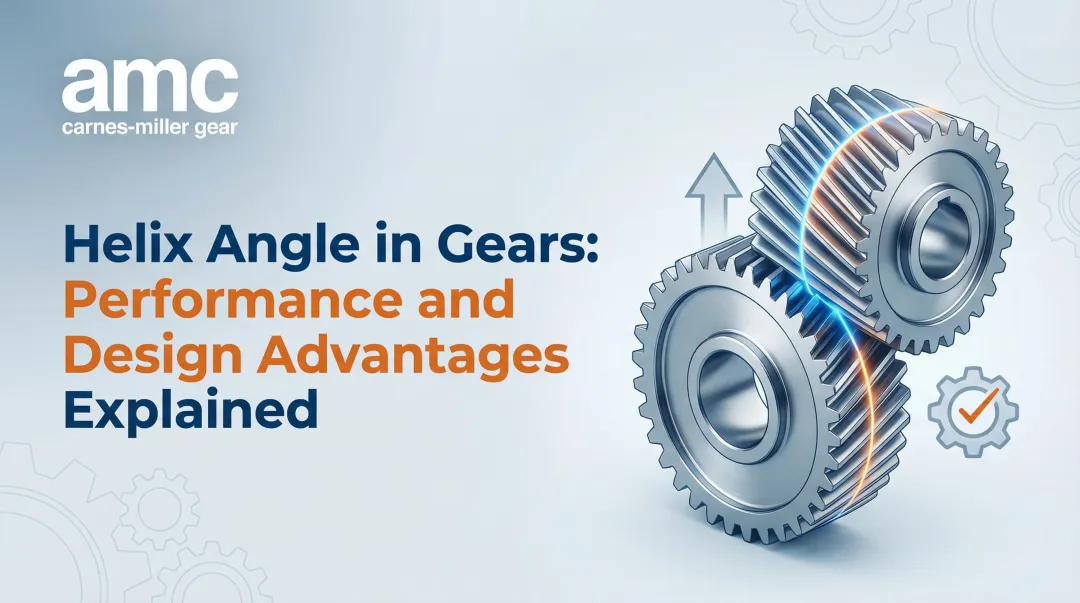
Helical gears are cylindrical gears with teeth cut at an angle (helix angle) to the gear axis, creating a spiral pattern that enables gradual tooth engagement. Unlike spur gears where teeth engage abruptly across their full width, helical teeth make contact progressively from one end to the other.
For manufacturing applications, helical gears solve critical operational challenges in parallel-shaft configurations.
They're essential where smooth power transmission, reduced noise, and high-speed capability matter most—common requirements in industrial machinery, automotive systems, and material handling equipment.
Core operational benefits include:
- Smooth, quiet operation reduces noise and equipment wear while improving operator comfort
- Higher load capacity than spur gears through multiple teeth in contact
- Gradual tooth engagement minimizes shock loads and vibration in continuous-duty applications
- 98-99.5% efficiency reduces energy costs in high-utilization operations
Axial thrust consideration: Helical gears generate thrust forces along the shaft axis due to angled teeth. This requires robust thrust bearings and proper shaft support, adding complexity to bearing selection. Double helical (herringbone) gears use opposing helix angles to cancel these thrust forces, though at higher manufacturing cost.
Understanding these thrust forces is essential when selecting the right helical gear configuration for your application.
Types and Variations of Helical Gears
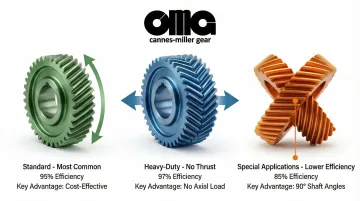
Single helical gears: Standard design with teeth angled in one direction. Most common and cost-effective option. Helix angles typically range from 15° to 45°—lower angles reduce thrust forces while higher angles provide smoother operation. Suitable for most parallel-shaft industrial applications.
Double helical (herringbone) gears: Feature two sets of helical teeth angled in opposite directions, canceling axial thrust. Ideal for high-torque, heavy-duty applications like cement mill drives and large industrial gearboxes where thrust forces would otherwise require expensive bearing configurations.
Crossed helical gears: Special application where helical gears mesh at an angle on non-parallel, non-intersecting shafts. Lower efficiency (70-95%) due to point contact rather than line contact. Useful for specific spatial constraints but not suitable for high-load applications.
Use Cases of Helical Gears
Industrial applications: Manufacturers use helical gears in conveyor systems, rolling mills, crushers, and material handling equipment where smooth, continuous operation directly impacts production efficiency. The gradual tooth engagement prevents shock loads that cause premature wear in heavy-duty cycles.
Automotive and transportation: Essential in automotive transmissions where compact design, quiet operation, and high-speed capability are critical requirements. The superior noise characteristics make helical gears the standard choice for passenger vehicle transmissions.
Mining sector example: In mining operations, helical gear motors lead the market due to their efficiency and cost-effectiveness in mechanical power transmission for conveyors and material handling systems operating in continuous-duty cycles.
What is a Bevel Gear?
Bevel gears are cone-shaped gears designed to transmit power between intersecting shafts, typically at 90-degree angles. Their teeth taper toward the apex of the cone, creating a geometry that enables efficient directional changes in power transmission.
In manufacturing environments, bevel gears solve a critical challenge: equipment layouts requiring compact designs with directional changes. They enable right-angle drives in space-constrained industrial settings where parallel-shaft configurations aren't feasible.
Core operational benefits:
- Enable right-angle power transmission for compact equipment layouts, reducing overall machinery footprint
- High torque capacity in heavy-duty applications reduces equipment size and weight compared to alternative drive configurations
- Spiral variants provide smooth, quiet operation comparable to helical gears, with research showing up to 16 dB noise reduction
- Versatile shaft angle options (45°, 60°, 90°, 120°) fit diverse design requirements beyond standard right-angle drives
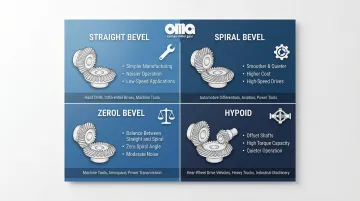
Key bevel gear types:
| Type | Characteristics | Best Applications |
|---|---|---|
| Straight Bevel | Straight teeth, simpler manufacturing, noisier operation | Low-speed applications, hand tools, cost-sensitive projects |
| Spiral Bevel | Curved teeth, smoother/quieter, higher cost | High-speed/high-torque drives, aerospace, marine propulsion |
| Zerol Bevel | Curved teeth with zero spiral angle | Balance between straight and spiral characteristics |
| Hypoid | Offset shafts, maximum smoothness | Automotive differentials, applications requiring shaft offset |
Manufacturing and Precision Considerations
Bevel gears require precise manufacturing due to complex conical geometry and tooth profiles. High precision ratings like AGMA 13 demand gear grinding processes controlling tooth geometry within microns.
Critical manufacturing factors:
- Bevel gear pairs are often manufactured together as matched sets to ensure proper mesh geometry
- Replacing a single gear without its matched partner can lead to premature failure from improper tooth contact patterns
- Spiral bevel gears require specialized equipment (Gleason or Klingelnberg machines), significantly increasing manufacturing complexity and cost
- Precision alignment during installation is essential—misalignment increases bearing loads and reduces efficiency
Use Cases of Bevel Gears
Industrial and heavy machinery: Commonly found in differential drives, right-angle gearboxes, printing presses, conveyor systems, and material handling equipment where directional changes are required. Cooling tower gearboxes commonly employ bevel gears for their compact right-angle drive capability.
Marine and automotive: Marine propulsion systems rely on bevel gears to redirect engine output to propeller shafts. Automotive differentials use hypoid gears (a bevel gear variant) for their smooth operation and ability to lower the driveshaft position.
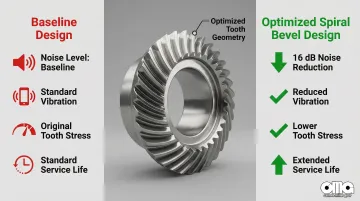
Aerospace application: Helicopter transmission research on the OH-58D main-rotor drive demonstrated that optimized spiral bevel gear designs achieved 16 dB noise reduction at 100% torque compared to baseline designs, while simultaneously reducing pinion tooth stresses. This performance improvement came from modified tooth geometry that minimized transmission error—the primary driver of gear noise and vibration.
Helical vs Bevel Gears: What is Better?
Neither helical nor bevel gears is universally "better"—optimal selection depends on specific application requirements. The decision hierarchy should follow this order:
1. Shaft Configuration (Primary Decision Factor)
Parallel shafts: Helical gears are required. They cannot handle angular transmission.
Intersecting shafts (typically 90°): Bevel gears are required. Helical gears cannot transmit power between intersecting axes.
Non-intersecting, non-parallel shafts: Consider crossed helical gears (lower efficiency) or worm gears depending on reduction ratio requirements.
2. Performance Comparison for Parallel-Shaft Applications
When shaft configuration theoretically allows either option (rare in practice):
Helical advantages:
- Slightly higher efficiency (98-99.5% vs. 98-99%)
- Superior noise reduction from gradual engagement
- Simpler bearing requirements (except for thrust force management)
- More cost-effective manufacturing for standard configurations
Bevel considerations:
- Specific space constraints requiring unique gear train configurations
- Directional flexibility needed in multi-stage drives
3. Performance Comparison for Intersecting-Shaft Applications
When bevel gears are required by shaft geometry:
Straight bevel gears: Best for cost-effectiveness in moderate-speed applications with acceptable noise levels.
Common in hand tools, basic machinery, and applications under 1,000 RPM.
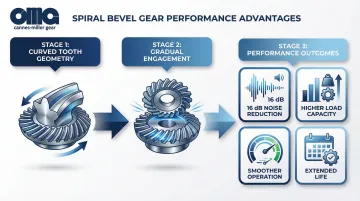
Spiral bevel gears: Ideal for high-speed (>1,000 RPM), high-torque, or noise-sensitive applications.
The curved tooth geometry provides:
- Significantly quieter operation (up to 16 dB reduction in research studies)
- Higher load capacity from increased contact ratio
- Smoother operation at high speeds
- Extended service life in demanding applications
Hypoid gears: Use when shaft offset is required (common in automotive differentials) and maximum smoothness is essential, despite the 90-98% efficiency tradeoff.
4. Situational Recommendations
Helical gears work best for:
- Parallel shaft configurations
- High-speed operation (>1,500 RPM)
- Maximum efficiency (critical for energy cost reduction)
- Noise-sensitive environments
- Applications: Conveyors, automotive transmissions, industrial drives
Straight bevel gears are optimal when:
- Right-angle drive is required
- Speeds are moderate (<1,000 RPM)
- Cost sensitivity is high
- Applications: Hand tools, basic machinery, low-speed right-angle drives
Spiral bevel gears excel in:
- Right-angle drive applications
- High torque and smooth operation requirements
- Noise-critical environments
- Applications: Marine propulsion, aerospace, heavy equipment, high-speed right-angle drives
Double helical gears handle:
- Parallel shafts with high torque demands
- Applications where axial thrust forces must be eliminated
- Applications: Cement mills, large industrial gearboxes, heavy-duty continuous operation
Hypoid gears fit applications requiring:
- Shaft offset configurations
- Maximum smoothness
- Acceptable efficiency tradeoff (90-98%)
- Applications: Automotive differentials
Real World Examples and Case Studies
Aerospace: Helicopter Transmission Noise Reduction
Operational Challenge: The OH-58D helicopter main-rotor transmission experienced excessive noise and vibration levels, primarily from spiral bevel gear mesh. High noise levels impacted crew comfort, communication effectiveness, and contributed to component fatigue in the transmission system.
Decision-Making Process: Engineers focused on reducing transmission error—the primary driver of gear noise and vibration. They redesigned the spiral bevel gear tooth geometry to minimize transmission error through advanced profile modifications.
The selection of spiral bevel gears (rather than straight bevel) was essential because the application required high-speed, high-torque right-angle power transmission where straight bevel gears would be inadequate.
Measurable Outcomes:
- Noise reduction: Approximately 16 dB decrease at 100% torque compared to baseline design
- Vibration improvement: Significant reductions in measured vibration levels throughout the torque range
- Stress reduction: Lower pinion tooth stresses compared to the original design
- Operational impact: Improved cabin comfort and extended component service life from reduced dynamic loads
Practical Takeaway: For demanding right-angle applications requiring high speeds and heavy loads, investing in precision-ground spiral bevel gears with optimized tooth geometry delivers measurable performance improvements. The 16 dB noise reduction demonstrates how manufacturing precision—particularly achieving tight tolerances on tooth geometry—directly impacts operational performance in critical applications.
Applications with similar noise, vibration, or durability requirements often benefit from precision grinding capabilities. Carnes-Miller Gear manufactures custom spiral bevel and helical gears with AGMA 13-rated precision for aerospace, defense, and industrial power transmission systems. Contact the team at 704-888-4448 or dan@cmgear.us to discuss your specific application requirements.
Conclusion
The helical versus bevel gear decision hinges primarily on shaft configuration—parallel shafts demand helical gears, while intersecting shafts require bevel gears. Beyond this fundamental constraint, performance requirements like speed, load, noise tolerance, and space limitations guide the selection of specific variants.
Both gear types achieve excellent efficiency (98-99.5%) and durability when manufactured to proper precision standards. The critical factor isn't which gear type is inherently "better," but rather which is correctly matched to your application's geometric constraints and performance requirements.
Choosing the right gear type and ensuring precision manufacturing delivers measurable benefits:
- Reduced energy consumption
- Extended equipment lifespan
- Minimized maintenance downtime
- Quieter operations
- Lower total cost of ownership
For manufacturers in aerospace, defense, mining, and heavy industrial sectors operating continuous-duty equipment, these factors compound over time. Custom gear manufacturers like Carnes-Miller Gear achieve AGMA 10 ratings on shaped and hobbed gears and AGMA 13 ratings on ground gears, delivering the precision standards required for high-performance applications across these demanding industries.
Frequently Asked Questions
How do helical and bevel gears compare in efficiency, durability, and disadvantages?
Both achieve 98-99.5% efficiency with proper manufacturing. Helical gears excel in high-speed continuous operation, while spiral bevel gears handle heavy shock loads better. The main disadvantage: helical gears produce axial thrust requiring robust bearings, while straight bevel gears are noisier and more complex to manufacture.
What are the different types of gears?
The three main categories are parallel-axis gears (spur, helical, internal), intersecting-axis gears (straight bevel, spiral bevel, miter), and non-parallel, non-intersecting gears (worm, crossed helical). Helical and bevel represent two of the most common industrial gear types.
When should I choose helical gears over bevel gears?
Choose helical gears for parallel-shaft applications requiring high-speed operation, maximum efficiency, or smooth/quiet performance in continuous-duty cycles. If shafts intersect at an angle, bevel gears are required regardless of other factors.
What are the main disadvantages of helical gears?
Helical gears generate axial thrust force requiring robust thrust bearings, increasing system complexity and cost. They're limited to parallel-shaft applications and cannot accommodate directional changes. They're also more expensive to manufacture than simple spur gears due to angled tooth geometry.
Can helical and bevel gears be used together in a gear train?
Yes, they're commonly combined in multi-stage gear trains for both parallel-shaft transmission (helical) and directional changes (bevel). This combination is frequently used in industrial gearboxes, marine propulsion systems, and heavy machinery.
What is the difference between straight bevel and spiral bevel gears?
Straight bevel gears have straight teeth—simpler and less expensive but noisier, suited for speeds under 1,000 RPM. Spiral bevel gears feature curved teeth that engage gradually, providing smoother operation, higher load capacity, and quieter performance (up to 16 dB reduction) for high-speed applications, though at higher manufacturing cost.